Sydney Smirke British Museum Reading Room Open
| British Museum Reading Room | |
|---|---|
 Within the Reading Room, before its conversion to an exhibition space | |
 | |
| General information | |
| Town or city | Bloomsbury, London |
| Country | United kingdom of great britain and northern ireland |
| Coordinates | 51°31′x″North 00°07′37″W / 51.51944°N 0.12694°W / 51.51944; -0.12694 Coordinates: 51°31′10″North 00°07′37″W / 51.51944°N 0.12694°W / 51.51944; -0.12694 |
| Construction started | 1854 |
| Completed | 1857 |
| Technical details | |
| Structural organization | Segmented domed |
| Pattern and construction | |
| Architect | Sydney Smirke |
The British Museum Reading Room, situated in the centre of the Great Court of the British Museum, used to exist the master reading room of the British Library. In 1997, this role moved to the new British Library building at St Pancras, London, only the Reading Room remains in its original class at the British Museum.
Designed by Sydney Smirke and opened in 1857, the Reading Room was in continual employ until its temporary closure for renovation in 1997. It was reopened in 2000, and from 2007 to 2017 it was used to stage temporary exhibitions. As of 2021, it remains closed to the public while its future apply remains nether discussion.
History [edit]
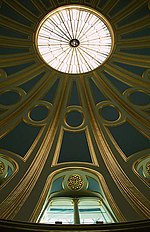
Detail of the ceiling with its oculus

A plan of the desks and book storage in the room

An analogy of the former book stacks in the museum earlier their removal
Construction and design [edit]
In the early 1850s the museum library was in need of a larger reading room and the then-Keeper of Printed Books, Antonio Panizzi, following an before competition idea by William Hosking, came up with the thought of a round room in the central courtyard. The building was designed past Sydney Smirke and was constructed betwixt 1854 and 1857. The edifice used cast iron, concrete, glass and the latest technology in ventilation and heating. The dome, inspired by the Pantheon in Rome, has a diameter of 42.half-dozen metres but is not technically free standing: constructed in segments on cast atomic number 26, the ceiling is suspended and made out of papier-mâché. Volume stacks built effectually the reading room were made of iron to accept the huge weight and add fire protection. In that location were forty kilometres of shelving in the stacks prior to the library'southward relocation to the new site.[1]
The British Museum Library [edit]
The Reading Room was officially opened on two May 1857 with a 'breakfast' (that included champagne and ice cream) laid out on the catalogue desks. A public viewing was held between 8 and 16 May, attracting over 62,000 visitors. Tickets to it included a programme of the library.[1] [ii]
Regular users had to utilise in writing and be issued a reader'due south ticket by the Principal Librarian.[1] During the period of the British Library, access was restricted to registered researchers only; still, reader's credentials were mostly bachelor to anyone who could evidence that they were a serious researcher. The Reading Room was used by a large number of famous figures, including notably Sun Yat-sen, Karl Marx, Oscar Wilde, Friedrich Hayek, Marcus Garvey, Bram Stoker, Mahatma Gandhi, Rudyard Kipling, George Orwell, George Bernard Shaw, Mark Twain, Vladimir Lenin (using the proper noun Jacob Richter[i]), Virginia Woolf, Arthur Rimbaud, Mohammad Ali Jinnah,[3] H. G. Wells[4] and Sir Arthur Conan Doyle.[ane]
In 1973, the British Library Deed 1972 detached the library department from the British Museum, simply information technology continued to host the now separated British Library in the same Reading Room and building as the museum until 1997. The British Museum Library yet exists, just as of 2011, the Reading Room is not open to the public.
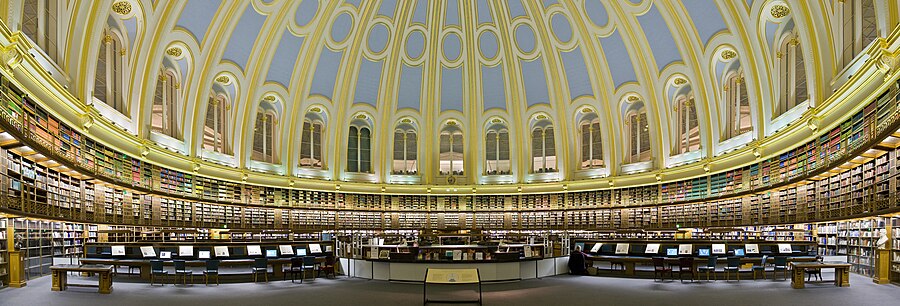
A panorama showing an almost 180-caste view of the interior of the Reading Room

Closure and restoration [edit]
In 1997 the British Library moved to its own specially constructed edifice next to St Pancras Station and all the books and shelving were removed. As part of the redevelopment of the Swell Court, the Reading Room was fully renovated and restored, including the papier-mâché ceiling which was repaired to its original colour scheme, having previously undergone radical redecorations (the initial design of the roof was considered excessive at the time).[1] [5]
The Reading Room was reopened in 2000, allowing all visitors, and not just library ticket-holders, to enter it. It held a collection of 25,000 books focusing on the cultures represented in the museum forth with an data eye and the Walter and Leonore Annenberg Centre.[one]
Exhibition space [edit]
In 2007 the books and facilities installed in 2000 were removed, and the Reading Room was relaunched as a venue for special exhibitions, beginning with one featuring Cathay's Terracotta Ground forces. The full general library for visitors (Paul Hamlyn Library) moved to a room attainable through nearby Room 2, but airtight permanently on thirteen August 2011. This is an before library that has as well had distinguished users, including Thomas Babington Macaulay, William Makepeace Thackeray, Robert Browning, Giuseppe Mazzini, Charles Darwin and Charles Dickens.[6] The Reading Room is no longer used for exhibitions.
A selection of past exhibitions:[7]
| Exhibit | From | To |
|---|---|---|
| The First Emperor: Communist china's Terracotta Army[viii] | thirteen September 2007 | half-dozen April 2008 |
| Hadrian: Empire and Disharmonize[9] [10] | 24 July 2008 | 27 Oct 2008 |
| Shah ʿAbbas: The Remaking of Islamic republic of iran[7] | 19 February 2009 | 14 June 2009 |
| Indian Summertime[7] | May 2009 | September 2009 |
| Montezuma: Aztec Ruler[7] | 24 September 2009 | 24 January 2010 |
| Italian Renaissance drawings[11] | 22 April 2010 | 25 July 2010 |
| Ancient Egyptian Book of the Dead: Journey Through the Afterlife[12] | four November 2010 | 6 March 2011 |
| Treasures of Sky: Saints, Relics and Devotion in Medieval Europe[13] | 23 June 2011 | nine October 2011 |
| Hajj: journeying to the centre of Islam | 26 January 2012 | 15 April 2012 |
| Shakespeare: staging the world | 19 July 2012 | 25 Nov 2012 |
| Life and expiry in Pompeii and Herculaneum | 28 March 2013 | 29 September 2013 |
| Vikings: life and legend[vii] | 6 March 2014 | 22 June 2014 |
| Ancient lives, new discoveries[7] | 22 May 2014 | 12 July 2015 |
| Germany: memories of a nation[7] | 16 Oct 2014 | 25 Jan 2015 |
| Indigenous Australia: enduring civilisations[7] | 23 April 2015 | ii August 2015 |
| Cartoon in silverish and gold: Leonardo to Jasper Johns[7] | x September 2015 | 6 Dec 2015 |
| Celts: art and identity[7] | 24 September 2015 | 31 Jan 2016 |
| Egypt: faith after the pharaohs[seven] | 29 October 2015 | 7 February 2016 |
| Sunken Cities: Egypt's lost worlds[vii] | xix May 2016 | 27 November 2016 |
| Hokusai: beyond the Swell Wave[seven] | 25 May 2017 | thirteen August 2017 |

The exterior of the Reading Room, in the Great Court
References in art and popular culture [edit]
The British Museum Reading Room is the subject of an eponymous poem, "The British Museum Reading Room", by Louis MacNeice. Much of the action of David Guild's 1965 novel The British Museum Is Falling Down takes identify in the erstwhile Reading Room. The 'Glass Ceiling' of Anabel Donald's 1994 novel is the ceiling of the Reading Room, where the denouement is set.
Alfred Hitchcock used the Reading Room and the dome of the British Museum every bit a location for the climax of his first sound film Blackmail (1929). Other movies with key scenes in the Reading Room include Night of the Demon (1957) and in the 2001 Japanese anime OVA Read or Die, the Room is used as a undercover entrance to the British Library's fictional "Special Operations Division".
In Sir Max Beerbohm's short story, Enoch Soames, get-go published in May 1916, an obscure writer makes a deal with the Devil to visit the Reading Room ane hundred years in the future, in order to know what posterity thinks about him and his work.
The British Museum and the Reading Room serve as the settings for An Run into at the Museum, an anthology of romance novellas by Claudia Dain and Deb Marlowe, amid others.
Virginia Woolf made reference to the British Museum Reading Room in a passage from her 1929 essay, A Room of One'south Ain. She wrote, "The swing doors swung open, and there one stood under the vast dome as if ane were a thought in the huge bald forehead which is so splendidly encircled past a band of famous names."[xiv]
Richard Henry Dana, Jr. visited the Reading Room on 10 September 1860 with his London friend Henry T. Parker, and reported that
Parker calls & takes me to the British Museum, to see the Reading Room, wh. has been congenital since 1856 [Dana's prior visit]. It is the room where students & readers take their desks, & consult the textbooks, cyclopedias, catalogs &c., & from wh. they send orders for books to the Library – the Library non being visited, at all, for report. There is no such room every bit this in Europe. Information technology is a circle, with a dome, lighted from in a higher place, & its diameter is 4 feet greater than that of the dome of St. Paul's. The autographs are now open to the view of all, spread out in drinking glass cases, – every bit well as much other lit. curiosities. This is the grandest Literary & Scientific institution (not for education) in the globe. The Reading Room, I told Parker, was a temple to the deification of Bibliology.[15]
The writer Bernard Falk (1882-1960) quotes the British historian Thomas Carlyle (1795-1881) as having declared that the Reading Room of the British Museum was a user-friendly aviary for imbeciles whose friends wished them out of mischief's fashion.[16]
References [edit]
- ^ a b c d due east f g "Reading Room". The British Museum . Retrieved 29 Apr 2020.
- ^ Invitation to a private view of the Round Reading Room, British Museum
- ^ Wolpert, Stanley Jinnah of Pakistan, p. xiii
- ^ Charles Godfrey-Faussett (one May 2004), Footprint England, Footprint Travel Guides, p. 884, ISBN978-1-903471-91-3
- ^ "BBC News | Entertainment | Facelift for British Museum's reading room". news.bbc.co.uk . Retrieved 29 April 2020.
- ^ "BM confirms closure of Paul Hamlyn library | Museums Clan". world wide web.museumsassociation.org . Retrieved 29 Apr 2020.
- ^ a b c d e f g h i j one thousand l m "British Museum - Past exhibitions". ix February 2018. Archived from the original on 9 Feb 2018. Retrieved 29 Apr 2020.
- ^ "British Museum - The First Emperor: Prc's Terracotta Army". 1 April 2019. Archived from the original on 1 Apr 2019. Retrieved 29 April 2020.
- ^ "British Museum - Archive: Hadrian". 23 March 2019. Archived from the original on 23 March 2019. Retrieved 29 April 2020.
- ^ "Hadrian: Empire and Conflict, British Museum, London". the Guardian. 19 July 2008. Retrieved 29 April 2020.
- ^ "British Museum - Archive: Fra Angelico to Leonardo: Italian Renaissance Drawings". 12 Oct 2018. Archived from the original on 12 October 2018. Retrieved 29 April 2020.
- ^ "British Museum - Book of the Expressionless". 28 Oct 2018. Archived from the original on 28 October 2018. Retrieved 29 April 2020.
- ^ "British Museum - Treasures of Heaven". five September 2019. Archived from the original on v September 2019. Retrieved 29 April 2020.
- ^ Hoberman, Ruth (Fall 2002). "Women in the British Reading Room During the Late-Nineteenth and Early-Twentieth Centuries: From Quasi- to Counterpublic". Feminist Studies. 28 (3): 489–512. doi:10.2307/3178782. JSTOR 3178782.
- ^ Richard H. Dana, Jr., Journal of a Voyage Circular the Earth 1859–1860, Library of America Ed. pp. 861–62 (2005)
- ^ Falk, Bernard (1951) Bouquets for Fleet Street, London, Hutchinson & Co, p.157
Farther reading [edit]
- A History of the British Museum Library, 1753–1973. London: British Library, 1998, ISBN 0-7123-4562-0, ISBN 978-0-7123-4562-0
- Caygill, Thousand. The British Museum Reading Room. London: The British Museum, 2000. ISBN 0-86159-985-iii
- Wilson, David M. The British Museum; A History. London: The British Museum Press, 2002, ISBN 0-7141-2764-7
External links [edit]
- British Museum Reading Room Information
Sydney Smirke British Museum Reading Room Open
Source: https://en.wikipedia.org/wiki/British_Museum_Reading_Room
0 Response to "Sydney Smirke British Museum Reading Room Open"
Post a Comment