My Baby Hasnt Had a Wet Diaper in 8 Hours
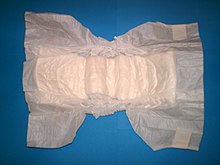
Within of a disposable baby diaper with resealable tapes and elasticated leg cuffs

Dissimilar kinds of outer diapers

A diaper /ˈdaɪpə(r)/ (American and Canadian English language) or a nappy (Australian English, British English, and Hiberno-English language) is a type of underwear that allows the wearer to urinate or defecate without using a toilet, by arresting or containing waste products to prevent soiling of outer wear or the external environment. When diapers become wet or soiled, they require irresolute, more often than not by a second person such equally a parent or caregiver. Failure to change a diaper on a sufficiently regular basis can result in peel bug around the area covered by the diaper.
Diapers are made of textile or synthetic dispensable materials. Cloth diapers are equanimous of layers of textile such every bit cotton, hemp, bamboo, microfiber, or even plastic fibers such as PLA or PU, and tin exist done and reused multiple times. Disposable diapers contain absorbent chemicals and are thrown away afterward apply.
Diapers are primarily worn by infants, toddlers who are non still toilet trained, and by children who experience bedwetting. They are besides used past adults nether sure circumstances or with various conditions, such as incontinence. Adult users can include those of advanced age, patients bed-bound in a hospital, individuals with certain types of physical or mental inability, and people working in extreme weather condition, such as astronauts. It is non uncommon for people to wear diapers under dry out suits.
History
Etymology
The Heart English word diaper originally referred to a type of material rather than the utilise thereof; "diaper" was the term for a pattern of repeated, rhombic shapes, and after came to describe white cotton or linen cloth with this pattern. According to the Oxford Lexicon, it is a piece of soft textile or other thick fabric that is folded effectually a babe'due south bottom and between its legs to absorb and concur its body waste.[2] The first fabric diapers consisted of a specific type of soft tissue canvas, cut into geometric shapes. The design visible in linen and other types of woven fabric was called "diaper". This significant of the word has been in utilise since the 1590s in England. By the 19th century, babe diapers were being sewn from linen, giving us the modern-day reading of the discussion "diaper".[3] This usage stuck in the U.s. and Canada following the British colonization of N America, but in the Great britain, the give-and-take "nappy" took its identify. Most sources believe nappy is a atomic class of the word napkin, which itself was originally a atomic.[four]
Evolution

Unpleasant duties (1631) by Adriaen Brouwer, depicting the changing of a diaper
In the 19th century, the mod diaper began to have shape and mothers in many parts of the world used cotton wool fabric, held in identify with a fastening—eventually the rubber pin. Cloth diapers in the United States were first mass-produced in 1887 past Maria Allen. In the UK, nappies were made out of terry towelling, often with an inner lining fabricated out of soft muslin.
Hither is an excerpt from 'The Modern Home Md' written by physicians in the UK in 1935.
Overnice erstwhile, soft bits of good Turkish towelling, properly washed, will make the softest of diaper coverings, inside which especially absorptive napkins (diapers), see below at 1A, soft, light, and easily washed, are contained. These should rarely be soiled one time regular habits have been inculcated, peculiarly during the nighttime menses in which it is nigh important to foreclose habit formation
1A -(squares of butter muslin or Harrington's packed rolls of "mutton cloth" in packets, sold for polishing motor-cars, would do equally well and are very cheap and soft)
Wool pants, or, in one case available, rubber pants, were sometimes used over the cloth diaper to forestall leakage. Doctors believed that rubber pants were harmful because they thought the rubber acted as a poultice and damaged the skin of infants.[ commendation needed ] The abiding problem to exist overcome was diaper rash, and the infection thereof. The concern was that lack of air circulation would worsen this condition. While lack of air circulation is a gene, it was afterward found that poor hygiene involving inefficiently done diapers and infrequent changes of diapers, along with allowing the baby to lie for prolonged periods of time with fecal matter in contact with the skin, were the two main causes of these problems.[ citation needed ]
In the 20th century, the disposable diaper was conceived. In the 1930s, Robinsons of Chesterfield had what were labeled "Destroyable Babies Napkins" listed in their catalogue for the wholesale market.[5] In 1944, Hugo Drangel of the Swedish newspaper company Pauliström suggested a conceptual design which would entail the placing of sheets of paper tissue (cellulose wadding) inside the cloth diaper and rubber pants. However, cellulose wadding was crude against the pare and crumbled into balls when exposed to wet.
In 1946, Marion Donovan used a shower curtain from her bath to create the "Boater", a diaper cover made from army surplus nylon parachute material. Showtime sold in 1949 at Saks 5th Avenue's flagship store in New York City, patents were later issued in 1951 to Donovan, who later sold the rights to the waterproof diaper for $1 meg.[half-dozen] Donovan also designed a paper disposable diaper, just was unsuccessful in marketing it.[7] In 1947, Scottish housewife Valerie Hunter Gordon started developing and making Paddi, a 2-role system consisting of a dispensable pad (made of cellulose wadding covered with cotton fiber wool) worn inside an adjustable plastic garment with press-studs/snaps. Initially, she used old parachutes for the garment. She practical for the patent in April 1948, and information technology was granted for the UK in Oct 1949. Initially, the large manufacturers were unable to see the commercial possibilities of dispensable nappies. In 1948, Gordon fabricated over 400 Paddis herself using her sewing motorcar at the kitchen table. Her husband had unsuccessfully approached several companies for help until he had a gamble meeting with Sir Robert Robinson at a business dinner. In Nov 1949 Valerie Gordon signed a contract with Robinsons of Chesterfield who then went into full production. In 1950, Boots Britain agreed to sell Paddi in all their branches. In 1951 the Paddi patent was granted for the US and worldwide. Soon afterwards that, Playtex and several other large international companies tried unsuccessfully to buy out Paddi from Robinsons. Paddi was very successful for many years until the advent of 'all in 1' diapers.[8] [9]
In Sweden, Hugo Drangel'south daughter Lil Karhola Wettergren, in 1956 elaborated her father'southward original idea, by adding a garment (again making a two-function system like Paddi). Nonetheless she met the aforementioned problem, with the purchasing managers, declaring they would never allow their wives to "put paper on their children."[10] [ unreliable source? ]
Subsequently the 2d World War, mothers increasingly wanted freedom from washing diapers then that they could work and travel, causing an increasing demand for disposable diapers.[eleven]
During the 1950s, companies such as Johnson and Johnson, Kendall, Parke-Davis, Playtex, and Molnlycke entered the disposable diaper marketplace, and in 1956, Procter & Gamble began researching disposable diapers. Victor Mills, along with his project grouping including William Dehaas (both men who worked for the company) invented what would exist trademarked "Pampers". Although Pampers were conceptualized in 1959, the diapers themselves were not launched into the market until 1961.[12] Pampers at present accounts for more $10 billion in annual revenue at Procter & Run a risk.[13]
'The Engineering of a Disposable Diaper' - video by Neb Hammack
Over the side by side few decades, the disposable diaper industry boomed and the competition between Procter & Risk's Pampers and Kimberly Clark's Huggies resulted in lower prices and desperate changes to diaper design. Several improvements were fabricated, such as the use of double gussets to better diaper fit and containment. As stated in Procter & Adventure'southward initial 1973 patent for the utilise of double gussets in a diaper, "The double gusset folded areas tend to readily conform to the thigh portions of the leg of the infant. This allows quick and piece of cake plumbing equipment and provides a snug and comfortable diaper fit that volition neither bind nor wad on the baby…every bit a event of this snugger fit obtained because of this fold configuration, the diaper is less probable to leak or, in other words, its containment characteristics are greatly enhanced."[xiv] Further developments in diaper design were made, such as the introduction of refastenable tapes, the "hourglass shape" so as to reduce bulk at the crotch area, and the 1984 introduction of super-absorbent material from polymers known as sodium polyacrylate that were originally adult in 1966.[15] [16]
Types
Disposable

A baby wearing a disposable diaper
The first waterproof diaper comprehend was invented in 1946 past Marion Donovan, a professional-turned-housewife who wanted to ensure her children's wearable and bedding remained dry while they slept.[17] She likewise invented the starting time paper diapers, simply executives did not invest in this idea and it was consequently scrapped for over ten years until Procter & Gamble used Donovan's blueprint ideas to create Pampers. Another disposable diaper design was created past Valerie Hunter Gordon and patented in 1948[xviii] [19]
E'er since their introduction production innovations include the use of superabsorbent polymers, resealable tapes, and elasticised waist bands. They are now much thinner and much more absorbent. The product range has more recently been extended into children's toilet training stage with the introduction of grooming pants and pant diapers, which are now undergarments.
Modernistic dispensable baby diapers and incontinence products have a layered construction,[twenty] which allows the transfer and distribution of urine to an absorptive core construction where information technology is locked in. Basic layers are an outer crush of breathable polyethylene film or a nonwoven and film composite which prevents wetness and soil transfer, an inner absorbent layer of a mixture of air-laid paper and superabsorbent polymers for wetness, and a layer nearest the skin of nonwoven cloth with a distribution layer directly beneath which will transfer wetness to the absorbent layer.
Other mutual features of dispensable diapers include ane or more pairs of either adhesive or mechanical fastening tapes to keep the diaper securely attached. Some diapers have tapes which are refastenable to allow adjusting of fit or reapplication after inspection. Elasticized fabric single and double gussets around the leg and waist areas aid in fitting and in containing urine or stool which has not been absorbed. Some diapers lines now commonly include wetness indicators, in which a chemical included in the fabric of the diaper changes color in the presence of moisture to warning the carer or user that the diaper is wet.[21] A disposable diaper may likewise include an inner fabric designed to hold moisture against the skin for a brief menstruation before assimilation to alert a toilet grooming or bedwetting user that they take urinated. Most materials in the diaper are held together with the use of a hot-melt adhesive, which is applied in spray class or multi lines, an elastic hot melt is also used to help with pad integrity when the diaper is moisture.
Some disposable diapers include fragrance, lotions or essential oils in order to aid mask the smell of a soiled diaper, or to protect the skin. Intendance of dispensable diapers is minimal, and primarily consists of keeping them in a dry place before use, with proper disposal in a garbage receptacle upon soiling. Stool is supposed to be deposited in the toilet, but is by and large put in the garbage with the rest of the diaper.
Ownership the correct size of disposable diaper can exist a footling difficult for offset time parents since unlike brands tend to have different sizing standards. Baby diaper sizes in general are based on the child'southward weight (kg or lbs) and not determined past age similar in habiliment or shoes.[22]
Common disposable baby diaper brands in the United states include Huggies, Pampers, and Luvs.[22]
Sizing
| Diaper Size[22] | Infant Weight (lbs) | Babe weight (kg) | Approx Kid Age |
|---|---|---|---|
| N | <10 | <iv | outset few weeks but |
| 1 | 8-14 | 3-vi | two–4 months |
| 2 | 12-18 | 5-8 | four–vii months |
| 3 | sixteen-28 | vii-13 | 7–12 months |
| 4 | 22-37 | 9-17 | 18–48 months |
| v | >27 | >12 | older than 3 years |
| 6 | >35 | >16 | older than four years |
Cloth diaper
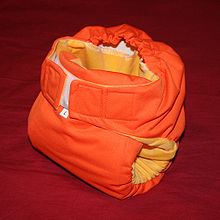
Cloth diaper filled with extra fabric
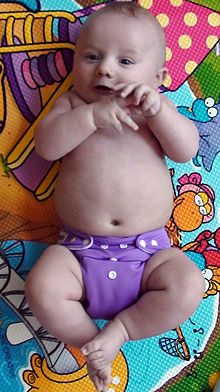
Fabric diapers are reusable and tin exist made from natural fibers, synthetic materials, or a combination of both.[23] They are often made from industrial cotton fiber which may be bleached white or left the fiber's natural color. Other natural fiber cloth materials include wool, bamboo, and unbleached hemp. Human being-made materials such as an internal absorptive layer of microfiber toweling or an external waterproof layer of polyurethane laminate (PUL) may be used. Polyester fleece and simulated suedecloth are oftentimes used inside cloth diapers as a "stay-dry" wicking liner because of the non-absorbent properties of those synthetic fibers.

Safe Diaper Clip from the mid-1960s
Traditionally, textile diapers consisted of a folded square or rectangle of fabric, fastened with safe pins. Today, most cloth diapers are fastened with hook and loop record (velcro) or snaps.
Modern cloth diapers come up in a host of shapes, including preformed textile diapers, all-in-ane diapers with waterproof exteriors, fitted diaper with covers and pocket or "stuffable" diapers, which consist of a water-resistant outer shell sewn with an opening for insertion of absorptive material inserts.[24] Many blueprint features of modernistic material diapers accept followed directly from innovations initially developed in disposable diapers, such equally the employ of the hour glass shape, materials to separate moisture from pare and the use of double gussets, or an inner elastic ring for better fit and containment of waste material.[23] Several cloth diaper brands apply variations of Procter & Gamble's original 1973 patent use of a double gusset in Pampers.[fourteen]
Usage
Children
Babies may have their diapers inverse five or more times a mean solar day.[25] Parents and other primary child care givers often carry spare diapers and necessities for diaper changing in a specialized diaper handbag. Diapering may possibly serve equally a good bonding experience for parent and child.[26] Children who vesture diapers may experience pare irritation, usually referred to as diaper rash, due to continual contact with fecal affair, as feces contains urease which catalyzes the conversion of the urea in urine to ammonia which can irritate the pare and tin cause painful redness.[27]
The age at which children should stop regularly wearing diapers and toilet training should begin is a subject of argue. Proponents of infant-led potty preparation and Elimination Communication argue that potty training tin begin at nascence with multiple benefits, with diapers but used as a fill-in. Keeping children in diapers beyond infancy can be controversial, with family psychologist John Rosemond challenge it is a "slap to the intelligence of a homo that ane would allow baby to go along soiling and wetting himself by age two."[28] Pediatrician T. Drupe Brazelton, however, believes that toilet grooming is the child's choice and has encouraged this view in diverse commercials for Pampers Size half dozen, a diaper for older children.[28] Brazelton warns that enforced toilet training can cause serious longterm issues, and that information technology is the child's conclusion when to end wearing diapers, non the parents'.[28] [29]
Children typically achieve daytime continence and stop wearing diapers during the day between the ages of two and four, depending on culture, diaper type, parental habits, and the child'southward personality.[xxx] Withal, it is becoming increasingly common for children as former as five to still be wearing diapers during the day, due to inability, the child's opposition to toilet training, or neglect. This can pose a number of issues if the child is sent to schoolhouse wearing diapers, including teasing from classmates and health issues resulting from soiled diapers.[31]
Most children continue to wear diapers at dark for a menstruation of time following daytime continence.[32] [33] Older children may have problems with bladder control (primarily at night) and may wear diapers while sleeping to control bedwetting.[34] Approximately 16% of children in the U.S. over the historic period of v wet the bed.[35] If bedwetting becomes a concern, the electric current recommendation is to consider forgoing the utilise of a diaper at nighttime as they may preclude the kid from wanting to get out of bed, although this is not a main crusade of bedwetting. This is particularly the case for children over the age of viii.[35] [36] [37]
Training pants
Manufacturers have designed "training pants" which bridge the gap between baby diapers and normal underwear during the toilet grooming process. These are similar to infant diapers in construction only they tin be put on like normal underwear. Training pants are bachelor for children who feel enuresis.
Adults
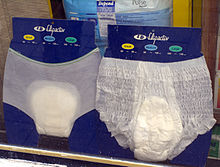
Adult diapers may be worn for urinary and fecal incontinence.
Although virtually usually worn by and associated with babies and children, diapers are also worn by adults for a diverseness of reasons. In the medical community, they are commonly referred to as "adult absorbent briefs" rather than diapers, which are associated with children and may have a negative connotation. The usage of adult diapers can be a source of embarrassment,[38] and products are ofttimes marketed under euphemisms such equally incontinence pads. The almost mutual adult users of diapers are those with medical conditions which cause them to experience urinary like bed wetting or fecal incontinence, or those who are bedridden or otherwise express in their mobility.
Scuba divers utilise diapers for their dry out suits for long exposures.[39] The Maximum Absorbency Garment is an adult-sized diaper with extra assimilation material that NASA astronauts wear during liftoff, landing, and extra-vehicular activity (EVA).[40] [41]
Animals
Diapers and diaperlike products are sometimes used on pets, laboratory animals, or working animals. This is often due to the animal not being housebroken, or for older, sick, or injured pets who take become incontinent. In some cases, these are just baby diapers with holes cut for the tails to fit through. In other cases, they are diaperlike waste collection devices.
The diapers used on primates, canines, etc. are much like the diapers used by humans. The diapers used on equines are intended to grab excretions, as opposed to absorbing them.
In 2002, the Vienna city council proposed that horses be fabricated to wear diapers to preclude them from defecating in the street. This caused controversy amongst animal rights groups, who claimed that wearing diapers would be uncomfortable for the animals. The campaigners protested by lining the streets wearing diapers themselves, which spelled out the message "Stop pooh bags".[42] In the Kenyan town of Limuru, donkeys were also diapered at the quango's behest.[43] A similar scheme in Blackpool ordered that horses be fitted with rubber and plastic diapers to stop them littering the promenade with dung. The council consulted the RSPCA to ensure that the diapers were not harmful to the horses' welfare.[44] [45] [46]
Other animals that are sometimes diapered include female dogs when ovulating and thus bleeding, and monkeys and apes or chickens.[47] Diapers are often seen on trained animals who appear on TV shows, in movies, or for live entertainment or educational appearances.
Cost of disposable diapers
More than than US$ix billion is spent on disposable diapers in North America each yr.[48]
Every bit of 2018, name-brand, mid-range disposable diapers in the U.S., such equally Huggies and Pampers, were sold at an average price of approximately $0.20–0.30 each, and their manufacturers earned near two cents in profit from each diaper sold.[48] Premium brands had eco-friendly features, and sold for approximately twice that toll.[48] Generic dispensable diapers cost less per diaper, at an average price of $0.xv each, and the typical manufacturer's profit was about one cent per diaper.[48] Nevertheless, the low-cost diapers needed to be changed more than frequently, so the total toll savings was limited, every bit the lower toll per diaper was offset by the need to purchase more diapers.[48]
In Latin America, some manufacturers sold disposable diapers at a price of approximately US$0.ten each.[48]
Environmental impact of cloth versus dispensable diapers
An average child will get through several thou diapers in their life.[49] Since disposable diapers are discarded afterward a single employ, usage of disposable diapers increases the brunt on landfill sites, and increased environmental awareness has led to a growth in campaigns for parents to use reusable alternatives such as cloth or hybrid diapers.[fifty] An estimated 27.4 billion disposable diapers are used each year in the US, resulting in a possible three.4 million tons of used diapers adding to landfills each year.[51] A discarded disposable diaper takes approximately 450 years to decompose.[52]
The environmental bear on of cloth equally compared to dispensable diapers has been studied several times. In i cradle-to-grave study sponsored by the National Association of Diaper Services (NADS) and conducted by Carl Lehrburger and colleagues, results stated that disposable diapers produce seven times more solid waste product when discarded and three times more waste product in the manufacturing procedure. In improver, effluents from the plastic, pulp, and paper industries are believed far more chancy than those from the cotton-growing and -manufacturing processes. Single-utilise diapers swallow less water than reusables laundered at home, but more than than those sent to a commercial diaper service. Washing textile diapers at habitation uses 50 to seventy gallons (approx. 189 to 264 litres) of water every three days, which is roughly equivalent to flushing the toilet 15 times a day, unless the user has a loftier-efficiency washing machine. An average diaper service puts its diapers through an average of 13 water changes, simply uses less water and energy per diaper than i laundry load at home.[53]
In Oct 2008, "An updated lifecycle assessment study for disposable and reusable nappies" by the United kingdom of great britain and northern ireland Environment Agency and Department for Surroundings, Food and Rural Affairs stated that reusable diapers can cause significantly less (up to 40 per cent) or significantly more damage to the surround than dispensable ones, depending mostly on how parents wash and dry out them. The "baseline scenario" showed that the divergence in green-house emissions was insignificant (in fact, disposables even scored slightly meliorate). Nevertheless, much better results (emission cuts of upwards to 40 per cent) could be achieved by using reusable diapers more rationally. "The study shows that, in contrast to the employ of disposable nappies, it is consumers' behaviour subsequently buy that determines most of the impacts from reusable nappies. Cloth nappy users can reduce their environmental impacts past:
- Line drying exterior whenever possible
- Tumble drying as little equally possible
- When replacing appliances, choosing more energy efficient appliances (A+ rated machines [according to the Eu environmental rating] are preferred)
- Not washing in a higher place lx °C (140 °F)
- Washing fuller loads
- Using infant-led potty training techniques to reduce number of soiled nappies.
- Reusing nappies on other children."[54]
At that place are variations in the care of textile diapers that can account for different measures of environmental touch on. For instance, using a cloth diaper laundering service involves boosted pollution from the vehicle that picks up and drops off deliveries. Nonetheless such a service uses less h2o per diaper in the laundering process.[55] Some people who launder fabric diapers at abode launder each load twice, because the first wash a "prewash", and thus doubling the energy and water usage from laundering. Cloth diapers are near commonly made of cotton fiber. "Conventional cotton is one of the almost chemically-dependent crops, sucking up ten% of all agronomical chemicals and 25% of insecticides on 3% of our abundant land; that's more any other ingather per unit."[56] This effect tin be mitigated by using organic cotton or other materials, such every bit bamboo and hemp.[57]
Another aspect to consider when choosing between dispensable diapers and material diapers is cost. It is estimated that an boilerplate infant will use from $1,500 to $2,000 or more in dispensable diapers before being potty-trained.[58] In contrast, cloth diapers, while initially more expensive than disposables, if bought new cost near $100 to $300 for a basic set, although costs can rising with more expensive versions.[59] [60] The toll of washing and drying diapers must besides exist considered. The basic prepare, if i-sized, can last from birth to potty-training.
Another factor in reusable fabric diaper impact is the ability to re-utilize the diapers for subsequent children or sell them on. These factors can alleviate the environmental and financial bear upon from manufacture, sale and employ of brand-new reusable diapers.
Run into also
- Changing tabular array
- Diaper handbag
- Infant clothing
- Swim diaper
- Infant-led potty grooming
- Diaper fetishism
- Marion Donovan
- Grooming pants
References
- ^ "Diaper". Webster's Dictionary. The University of Chicago Department of Romance Languages and Literature. Archived from the original on May 25, 2013. Retrieved April 2, 2013.
- ^ "nappy". Oxford Avant-garde Learner'southward Lexicon. Archived from the original on Dec 13, 2021. Retrieved May 7, 2021.
- ^ "Diaper". eytomonline.com. Archived from the original on December 14, 2021. Retrieved November 10, 2009.
- ^ "Nappy". Oxford English Dictionary . Retrieved Nov 28, 2007.
{{cite encyclopedia}}: CS1 maint: url-condition (link) - ^ White, Peter (Jan 1, 2000). "9: From the Bottom Up". From Pill Boxes to Bandages... and Dorsum Over again: The Robinson Story 1839-2000. Chesterfield, United Kingdom: Robinson & Co. p. 75. ASIN B00AY5649M. Archived from the original on May 12, 2011. Retrieved March iii, 2011.
- ^ "Marion Donovan, 81, Solver Of the Damp-Diaper Problem". New York Urban center Times. November 18, 1998.
- ^ "No. 2464: Technology Diapers". uh.edu. Archived from the original on March iv, 2016. Retrieved April v, 2014.
- ^ Daily Telegraph
- ^ For more than information go to http://www.paddi.org.united kingdom of great britain and northern ireland Archived May 12, 2011, at the Wayback Machine
- ^ Pauliström Mill History
- ^ Center, Smithsonian Lemelson (July 1, 2000). "Papers Illustrate Woman Inventor's Life and Work". Lemelson Eye for the Written report of Invention and Innovation . Retrieved June sixteen, 2019.
- ^ "The Politics of Diapers". Archived from the original on September 4, 2009. Retrieved March 17, 2008.
- ^ "Pampers: The Birth of P&1000's Showtime 10-Billion-Dollar Brand". Archived from the original on March 24, 2014. Retrieved March 24, 2014.
- ^ a b Mario Due south Marsan. "Disposable Diaper Archived February 22, 2014, at the Wayback Machine", U.s. Patent 3710797, Issued January 16, 1973.
- ^ "The disposable diaper and the pregnant of progress – a brief history of diaper manufacturing". The New Yorker. Archived from the original on December 18, 2008. Retrieved November 11, 2008.
- ^ "The disposable diaper industry source – diaper history time line". Richer Investment. Archived from the original on July 23, 2011. Retrieved February 14, 2009.
- ^ Blattman, Elissa (2013), Three Every-twenty-four hour period Items Invented past Women, National Women's History Museum
- ^ "The History of Paddi". paddi.org.u.k.. Archived from the original on April 4, 2012. Retrieved August 1, 2012.
- ^ BBC – Radio4. "Home truth – Nappy days". Retrieved October twenty, 2011.
- ^ "How disposable diaper is made". How Products Are Fabricated. Retrieved March 17, 2008.
- ^ "What are the components used on a typical disposable diaper". Diaper Industry Source. Archived from the original on July 23, 2011.
- ^ a b c "Diaper Size Chart by Age, All Baby Diaper Sizes by Brand". Kinderzeit.org. Retrieved December xviii, 2018.
- ^ a b Leah S. Leverich (August 4, 2011). "Improved containment and convenience in a double gusset cloth diaper: Method of manufacture".
- ^ "Fabric Diapering". Archived from the original on March 30, 2008. Retrieved March 17, 2008.
- ^ Diapering Your Infant. Kidshealth.org. Retrieved on Apr 9, 2013.
- ^ Diaper Changes – Gentle Kid Care Archived December 23, 2007, at the Wayback Machine. Keepkidshealthy.com (December eight, 2004). Retrieved on April 9, 2013.
- ^ Diaper Rash: The Bottom Line Archived February 5, 2008, at the Wayback Car. Uspharmacist.com. Retrieved on April ix, 2013.
- ^ a b c Delayed Toilet Training Issues. Dy-dee.com. Retrieved on April 9, 2013.
- ^ Larkin, Patrick (July 22, 1998). "P&One thousand announces Pampers now a bigger disposable". The Cincinnati Post. Due east. Westward. Scripps Visitor. Archived from the original on May 8, 2006.
- ^ A. Honig "Toilet Training Stubbornness Archived March 12, 2007, at the Wayback Machine," Scholastic Parent and Child
- ^ Hannah Davies (June 5, 2008). "Parents sending kids to school in nappies". The Courier-Mail. Archived from the original on June 28, 2009. Retrieved June 5, 2008.
- ^ Services, Department of Wellness & Human. "Toilet training". www.betterhealth.vic.gov.au . Retrieved Dec fifteen, 2018.
- ^ "Top tips for dry nights". www.bbc.co.u.k. . Retrieved December 15, 2018.
- ^ The Bed Wetting Diaper Archived September 29, 2007, at the Wayback Motorcar. Bedwettingweb.com (February 12, 2007). Retrieved on April 9, 2013.
- ^ a b Jan E Drutz, MD, Naiwen D Tu, Md (August xv, 2017). Teresa K Duryea, MDLaurence South Baskin, MD, FAAP (ed.). "Patient education: Bedwetting in children (Beyond the Nuts)". UpToDate.com. UpToDate. Retrieved December fifteen, 2018.
{{cite web}}: CS1 maint: multiple names: authors listing (link) - ^ Bedwetting and diapers Archived July 17, 2007, at the Wayback Machine. Drpaul.com. Retrieved on April 9, 2013.
- ^ Page, Anthony. "The Bed-Wetting Report – Practise diapers prolong bedwetting?". Creativechildonline.com. Archived from the original on February 11, 2006. Retrieved Apr 9, 2013.
- ^ Stack, Jennie Borodko (February 2001). "When Y'all've Gotta Go, You've Gotta Go". Muscular Dystrophy Association. Retrieved Oct xi, 2017.
- ^ Harris, Richard (December 2009). "Genitourinary infection and barotrauma as complications of 'P-valve' apply in drysuit divers". Diving and Hyperbaric Medicine. 39 (4): 210–2. PMID 22752741. Archived from the original on May 26, 2013. Retrieved Apr 4, 2013.
- ^ Gerbis, Nicholas (March 3, 2011). "How did NASA change diapers forever?". How Stuff Works. Retrieved April 4, 2013.
- ^ Michael Barratt; Sam L. Pool (2008). Principles of Clinical Medicine for Space Flight. Springer. p. 384. ISBN978-0-387-98842-nine . Retrieved June 11, 2011.
- ^ "Row as horses told to habiliment nappies". BBC News. September twenty, 2002. Retrieved February 21, 2008.
- ^ "Acrimony at Republic of kenya donkey nappy plan". BBC News. July 17, 2007. Retrieved February 21, 2008.
- ^ "Blackpool horses to get nappies". BBC News. Oct 17, 2006. Retrieved February 21, 2008.
- ^ "Nappy plan for Blackpool horses". BBC News. November 13, 2007. Retrieved Feb 21, 2008.
- ^ "Equus caballus nappy plan given go-ahead". BBC News. November 22, 2007. Retrieved February 21, 2008.
- ^ Waters, Michael (August 2, 2018). "The booming business of luxury chicken diapers". The Outline . Retrieved August two, 2018.
- ^ a b c d eastward f McGrory, Kathleen (March 28, 2018). "The bottom line: One in 3 families can't afford diapers. Why are they so expensive?". Tampa Bay Times . Retrieved March 31, 2018.
- ^ "Welcome". babycottonbottoms.com. Archived from the original on September 24, 2010. Retrieved Oct vii, 2010.
- ^ "Cloth Diapers Vs Disposable.?". Cloth-Diaper.org. Archived from the original on Oct 13, 2010. Retrieved September fourteen, 2010.
- ^ Paul, Pamela (January ten, 2008). "Diapers Go Green". Fourth dimension. Archived from the original on January xiv, 2008. Retrieved January 12, 2008.
- ^ "Judge Time it Takes for Garbage to Decompose in the Environs" (PDF). NH Department of Environmental Services. Archived from the original (PDF) on Dec 24, 2018. Retrieved March 31, 2018.
- ^ Carl Lehrburger; C. 5. Jones; Jocelyn Mullen (1991). Diapers: Environmental Impacts and Lifecycle Analysis. C. Lehrburger.
- ^ "The Great britain Environment Agency / DEFRA report" (PDF). randd.defra.gov.uk.
- ^ "Science and Research Projects" (PDF). randd.defra.gov.uk. Retrieved Oct 7, 2010.
- ^ Green Basics: Organic Cotton, treehugger.com
- ^ "Windeln im Test – Unabhängiges Vergleichsportal". www.windeln-tests.de. Retrieved June xx, 2016.
- ^ Consumer Reports (July 8, 2009). "Cloth vs. disposable diapers: Getting started". Consumer Reports. Archived from the original on July 9, 2010. Retrieved November 15, 2010.
- ^ "Diaper Facts". Real Diaper Association. Archived from the original on August 14, 2004. Retrieved November xv, 2010.
- ^ "Waste product Direction". The Washington Post. Oct 21, 2007. Retrieved November fifteen, 2010.
My Baby Hasnt Had a Wet Diaper in 8 Hours
Source: https://en.wikipedia.org/wiki/Diaper
0 Response to "My Baby Hasnt Had a Wet Diaper in 8 Hours"
Post a Comment